Why Commercial Doors and Loading Docks Fail During Winter (And How to Prevent It)
Service calls for commercial doors spike during the first week of real cold. Doors that ran fine all fall stop halfway, levelers refuse to rise, and a spring that has been wearing out for months finally lets go at 6 a.m. with a trailer waiting.
Most overhead door failure in January traces back to a part that was already weak in October. The cold just finds it.
Springs and Cables Take the First Hit
Torsion springs do the heavy lifting on a sectional door, and every cycle wears them down a little. Steel loses some of its flexibility as temperatures drop, so a spring near the end of its cycle life is far more likely to break during a cold snap than in July. A frayed cable near the bottom bracket can hold through the fall and then part on a frozen morning.
High-cycle dock doors get there faster. A door opening 150 times a day can wear out a standard spring in a couple of years.
Grease Thickens and Operators Strain
Lubricants that work well at 20°C turn stiff well below freezing. Rollers drag, bearings bind, and the operator has to work harder to move the same door. Older motors trip on thermal overload or start reversing because the force setting reads the extra resistance as an obstruction. Staff often respond by turning the force setting up, which hides the real problem and weakens the safety function.
Photo eyes add their own trouble. Frost, condensation, and salt spray on the lenses cause false reversals, and doors end up being run on manual override, which defeats the purpose of the sensors.
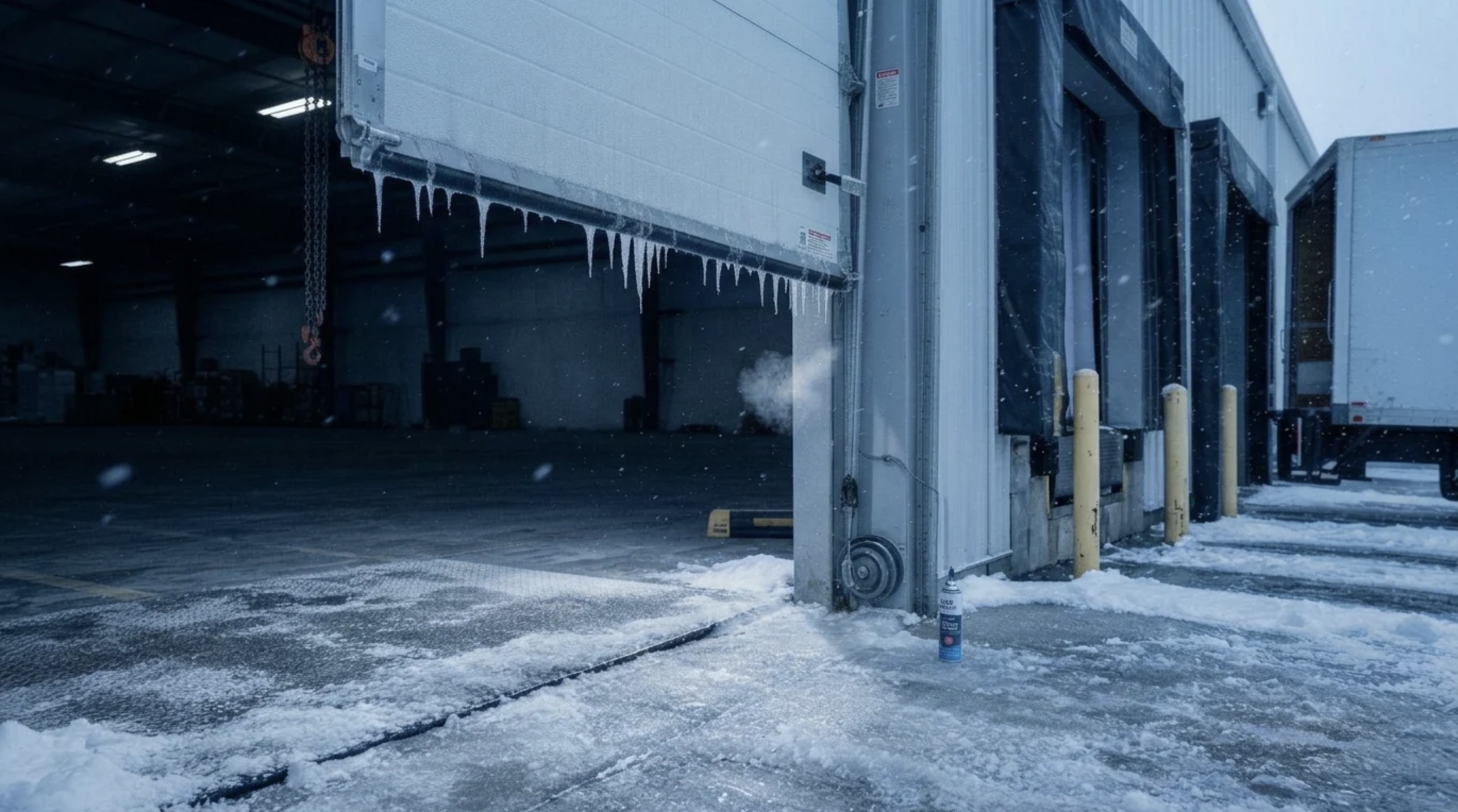
Ice Locks Doors to the Floor
Meltwater from trucks and snow tracked in by forklifts collects at the threshold and freezes overnight. The bottom seal bonds to the slab, and when the operator tries to lift the door, something gives. Usually it is the seal. Sometimes a cable comes off the drum or a bottom section bends. Ice in the vertical tracks can stop rollers just as effectively.
Hydraulic Levelers Lose Speed
Hydraulic fluid thickens in the cold, especially in pits exposed to outside air. Levelers rise slowly, the lip extends late or only partway, and pumps run longer than normal. Add salt, slush, and debris in the pit, and hinges start to stick. These are some of the most common loading dock problems in winter, and every truck at that door waits longer because of them.
Seals and Shelters Get Brittle
Foam pads and shelter curtains stiffen in the cold. A tired pad that still compressed in September cracks, and a curtain that has rubbed against trailer roofs for years finally tears. Beyond the heat loss, gaps around the trailer let snow and ice onto the leveler and the dock floor, right where forklifts are turning.
How to Prevent Winter Failures
Good commercial door winter maintenance comes down to finding the weak parts before the cold does:
- Replace springs and cables close to the end of their cycle rating before the first freeze
- Switch to lubricants rated for low temperatures and keep grease off the tracks
- Check force settings and test photo eyes and reversing edges on every door
- Keep thresholds and drains clear, and replace hardened bottom seals
- Check hydraulic fluid and clean out leveler pits before the snow arrives
- Look over seals, shelters, and bumpers for cracks and tears
A preventative maintenance program puts these checks on a schedule built around how hard each door works, so high-cycle positions get attention more often. Loading dock preventative maintenance done this way also leaves a record of what is wearing out, which makes it easier to budget for replacements instead of reacting to them.
If your equipment has not had a full review this season, Door Doctor’s 26-point dock and commercial door safety inspection covers your doors and dock equipment in one visit and comes with a same-day detailed report of what needs attention.
When Something Breaks Anyway
Even well-maintained equipment can fail in a long deep freeze. Keep the number for 24/7 emergency dock and door service posted at the dock, and train staff to take a damaged door out of service rather than forcing it. A door that has jumped its track or broken a spring can come down without warning, and that is how people get hurt.